
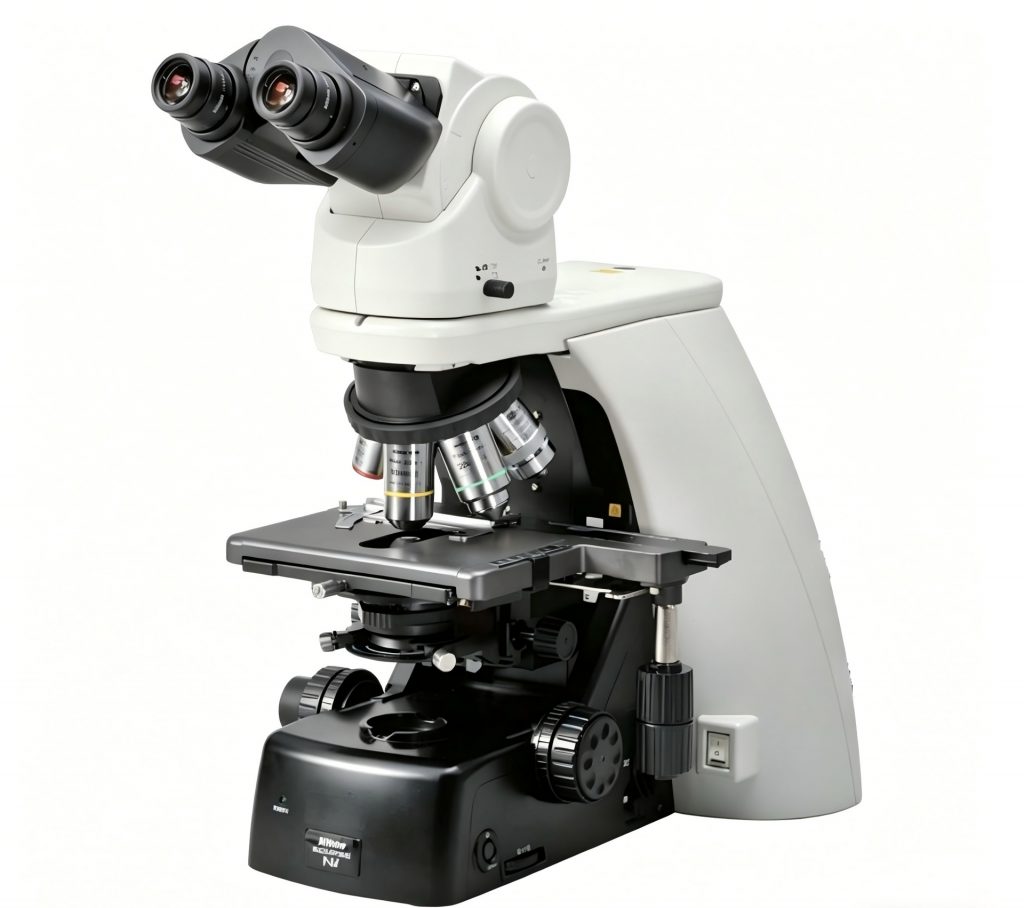
Cuihe provides enterprises with information related to Ni-L microscopes, Ni-L microscope prices, and Ni-L microscope parameters.
1.
Core technical features 1.
CFI60 optical system and wide-field observation capability Ni-L adopts Nikon CFI60 infinity-corrected optical system, which can be used with Plan Fluor, S Plan Fluor, Plan Apo, Apochromat Lambda and other series of scientific research-grade objective lenses.
According to different experimental needs, it can support multiple observation methods such as bright field, dark field, phase contrast, DIC, fluorescence and polarization, and is suitable for cytology, histology, pathological sections, immunostaining and routine scientific research sample observation.
The Ni-L supports an FN 22 or FN 25 field of view depending on tube and eyepiece configuration.
The FN 25 wide field of view configuration can provide a larger single observation range, reduce the number of frequent slide movements, and is suitable for large-area tissue section screening, pathological sample observation and digital image collection. 2.
LED transmitted lighting and intelligent light intensity management Ni-L has a built-in LED transmitted lighting system, which features low power consumption, low heat generation and long life.
The LED light source provides stable illumination suitable for long-term brightfield observation, tissue biopsy and routine laboratory use.
Ni-L supports LIM light intensity management function.
When the user switches between different objective lenses, the system can automatically call the corresponding lighting intensity according to the preset, reducing repeated manual dimming and improving observation comfort and operating efficiency.
This function is especially suitable for pathological observation, teaching experiments and routine scientific research microscopy that require frequent switching of magnifications. 3.
Linkage between intelligent coding and digital imaging Ni-L can be equipped with intelligent coding nosepiece and other components according to the configuration, which can transmit status information such as the current objective lens magnification to the imaging software.
When used with NIS-Elements, the software can automatically match the scale and acquisition parameters, reducing errors when manually selecting magnification or ruler, and improving the accuracy of image recording and data management.
Ni-L can be connected to a digital camera for image acquisition in brightfield, fluorescence and other observation modes.
For laboratories that require daily photography, image archiving, teaching demonstrations and basic quantitative analysis, Ni-L can provide better digital expansion capabilities. 4.
Multi-modal observation expansion capability Ni-L can support brightfield, darkfield, phase contrast, DIC, fluorescence and polarized observation methods according to configuration.
DIC differential interference observation is suitable for observation of stain-free transparent samples, cell boundaries and tissue details, and can present high-contrast images with a three-dimensional feel.
Fluorescence observation can be achieved through corresponding fluorescence illumination modules, filter blocks and camera configurations, and is suitable for routine immunofluorescence, tissue section fluorescence and multi-color labeled sample observation. 2.
Core application areas and configuration recommendations Application scenarios: Routine scientific research observation Applicable businesses: Cell biology, histology, immunostaining sample observation, routine bright field and fluorescence recording Configuration recommendations: Ni-L host, CFI60 series objective lens, FN 22 or FN 25 lens tube, digital camera, NIS-Elements software Application scenarios: Pathology and morphological observation Applicable businesses: HE staining, immunohistochemistry, tissue section observation, morphological grading, sample screening Configuration recommendations: LED Transillumination, Plan Fluor or Plan Apo objective lens, wide-field lens tube, digital camera Application scenario: Teaching laboratory Applicable businesses: Biology teaching, histology teaching, basic microscope training, classroom image demonstration Configuration recommendations: Ni-L host, commonly used magnification objectives, LED transmitted illumination, optional teaching observation accessories or digital imaging system Application scenario: Basic fluorescence observation Applicable businesses: Conventional immunofluorescence, observation of fluorescently labeled cells, fluorescence recording of tissue sections Recommended configuration: fluorescence illumination module, fluorescence filter block, fluorescence-specific objective lens, scientific research-grade or teaching-grade digital camera 3.
Application selection guidance Nikon ECLIPSE Ni-L is suitable for users who mainly focus on manual observation but also hope to obtain stable lighting, intelligent light intensity management, wide-field observation and digital recording capabilities.
For pathological observation, histological examination, routine scientific research microscopy, teaching experiments and basic fluorescence imaging, Ni-L can achieve a good balance between operating efficiency, image quality and system scalability.
If the laboratory requires high-throughput automated acquisition, motorized Z-axis, multi-channel automatic fluorescence, Z-Stack or complex software linkage, it is recommended to choose motorized platforms such as Ni-E.
If the main requirements are high-quality manual observation, stable LED illumination, routine morphological examination, and basic digital imaging, Ni-L is a more suitable choice.
Nikon ECLIPSE Ni-L is an advanced intelligent manual upright biological microscope stage in the Nikon Ni series.
It is designed for routine scientific research observation, pathology and histology sample observation, teaching laboratory, digital image recording and basic fluorescence applications.
The system uses the Nikon CFI60 infinity-corrected optical system, which features a stable body structure, LED transmitted illumination, intelligent light intensity management and good modular expansion capabilities.
It is suitable for laboratories that require high-quality manual observation and efficient sample screening.